Why Bresse poultry costs what it does
A Bresse capon can top a hundred euros. It's not marketing: it's written in black and white in its official specifications.

At the Christmas market, you walk past the poultry stall. The Bresse capon is there, with its leg band and its label. A glance at the price, a quick calculation, and you leave with a turkey.
You weren't wrong. Still, here's what you were paying for: that price doesn't come out of a marketing department, it follows from official specifications. Behind every line, a cost.
A protected designation since 1957
Since a law of August 1, 1957, Bresse poultry has been protected, then registered as a European PDO in 1996 (INAO specifications, 2018; Official Journal of the EU). Its area covers 275 municipalities spread over three departments: the Ain, the Jura and the Saône-et-Loire (INAO).
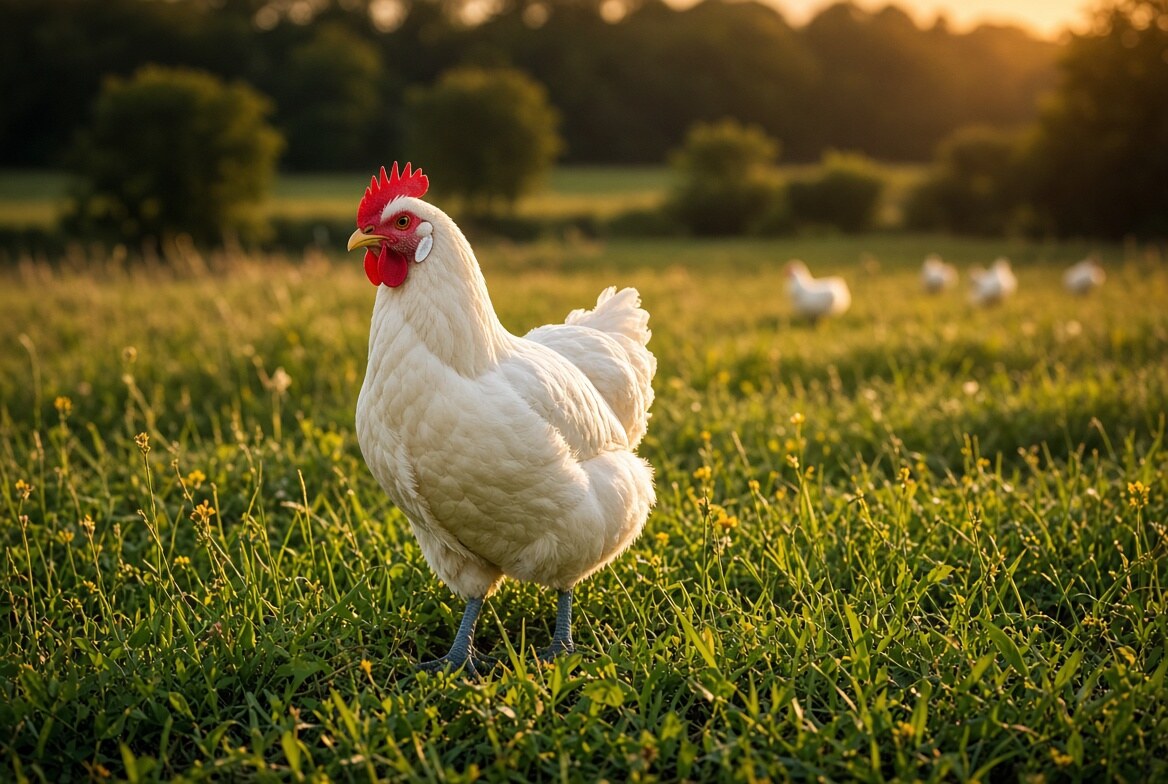
As for breed, no choice: the Gauloise, or Bresse breed, white variety. White feathers, bluish legs, nothing else (specifications).
108 days minimum: time
Before 108 days, no slaughter for a Bresse chicken. A poularde waits 140 days, a capon 224 days, more than seven months (specifications).
Every extra day is a day of feed, care and space. Cut it short? Impossible, it's a legal minimum.
10 m² per bird: space
At least 10 m² (108 sq ft) of meadow per bird. Not a vacant lot: a grassy meadow more than a year old, holding no more than 1,500 birds per hectare per year. In the shed, 700 birds at most (specifications).
In other words, a lot of land for few animals. And land costs money.
Corn and milk: the feed
In the feeder: grains from the area, with at least 40% corn, and dairy products: at least 4 liters (1 gallon) of milk (or 500 g / 1.1 lb of powder) per chicken, twice that for a capon (specifications).
This ration is deliberately low in protein: the bird has to find the rest itself on the meadow (Pleinchamp, 2021). It grows more slowly. That's the point.
Three weeks in the épinette: the finishing
Before slaughter, the birds go into the épinette: an individual cage, under shelter, where they're fed for finishing. Allow at least 10 days for a chicken, three weeks for a poularde, four for a capon (specifications).
How to recognize the real thing?
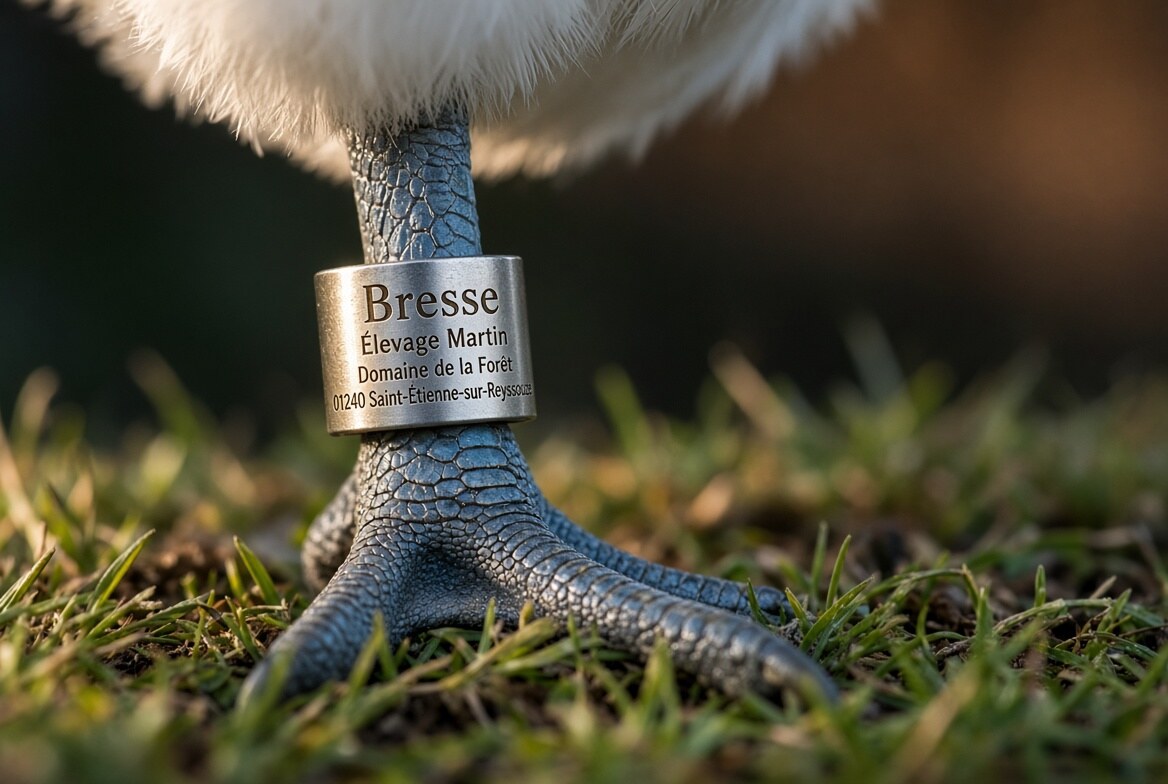
Three marks, applied at three stages: a band on the leg with the farmer's name, a seal at the base of the neck, and a label (specifications). If one is missing, walk on by.
So, how much?
On price, a capon sells for about €100 to €150 apiece at the farm, for a bird of 3.5 to 5 kg (7.7 to 11 lb) (Europe 1, December 2023). We couldn't find a reliable, recent source to compare with the price of a standard chicken, so we won't venture a figure for the gap.
What we can say: for a chicken, you're paying for at least 108 days of life, 10 m² of meadow and a finishing period in the épinette. Nothing like an ordinary chicken: it's another way of raising birds.
Finally, every December, the best breeders gather at the Glorieuses de Bresse, a competition held since 1865 (Auvergne-Rhône-Alpes Tourisme).
The verdict If Bresse poultry is expensive, it's because the law requires it to live long, outdoors, and eat local. You're not paying for a label: you're paying for time and meadow.
To go further
- Bresse and its recipes
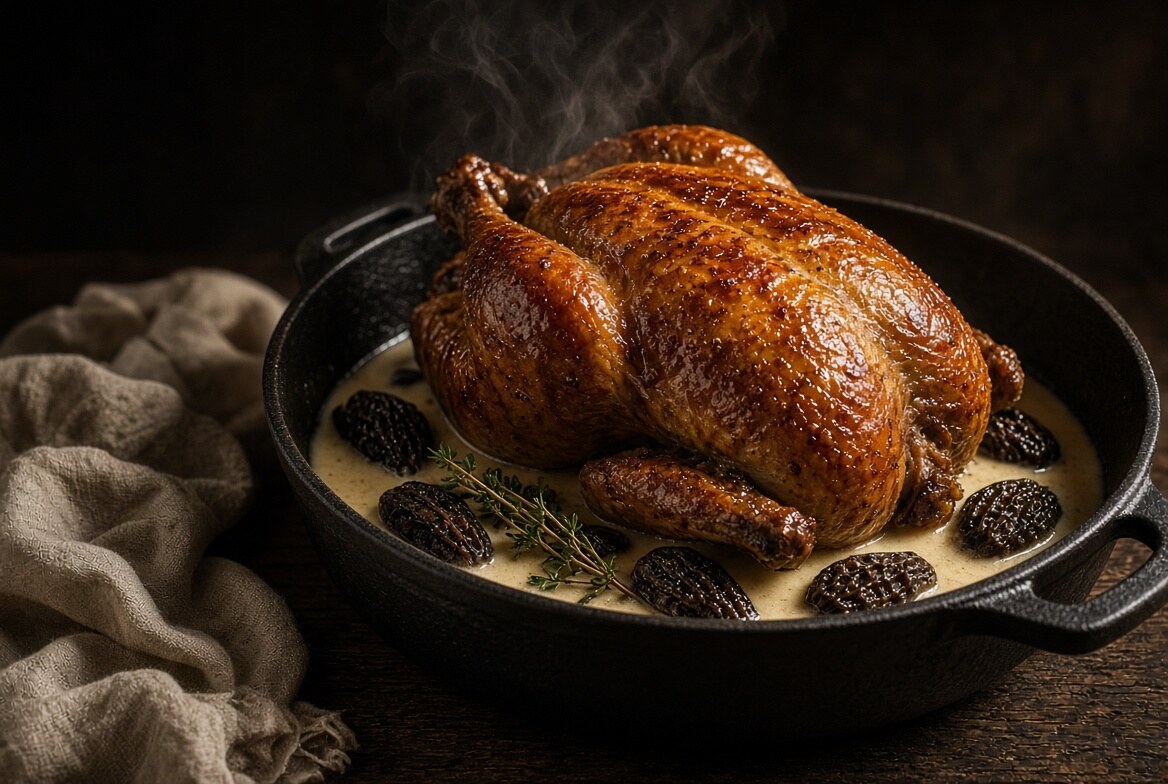
- Poulet de Bresse à la crème et aux morilles
- Poularde de Bresse au vin jaune
- Gâteau de foies blonds de Bresse
Sources — Volaille de Bresse PDO specifications, INAO, 2018 · INAO, designation fact sheet · Implementing Regulation (EU) 1121/2013 · Pleinchamp, 2021 · Europe 1, 2023 · Auvergne-Rhône-Alpes Tourisme
Image credits — All images in this article are AI-generated for Le Chaudron (illustrations, not documentary photos).