Chestnut or “marron”: what you're really buying
At the market stall, the sign says “marrons.” In the bag, they're almost always châtaignes. The real difference, the one trap to avoid, and how to choose and cook them.
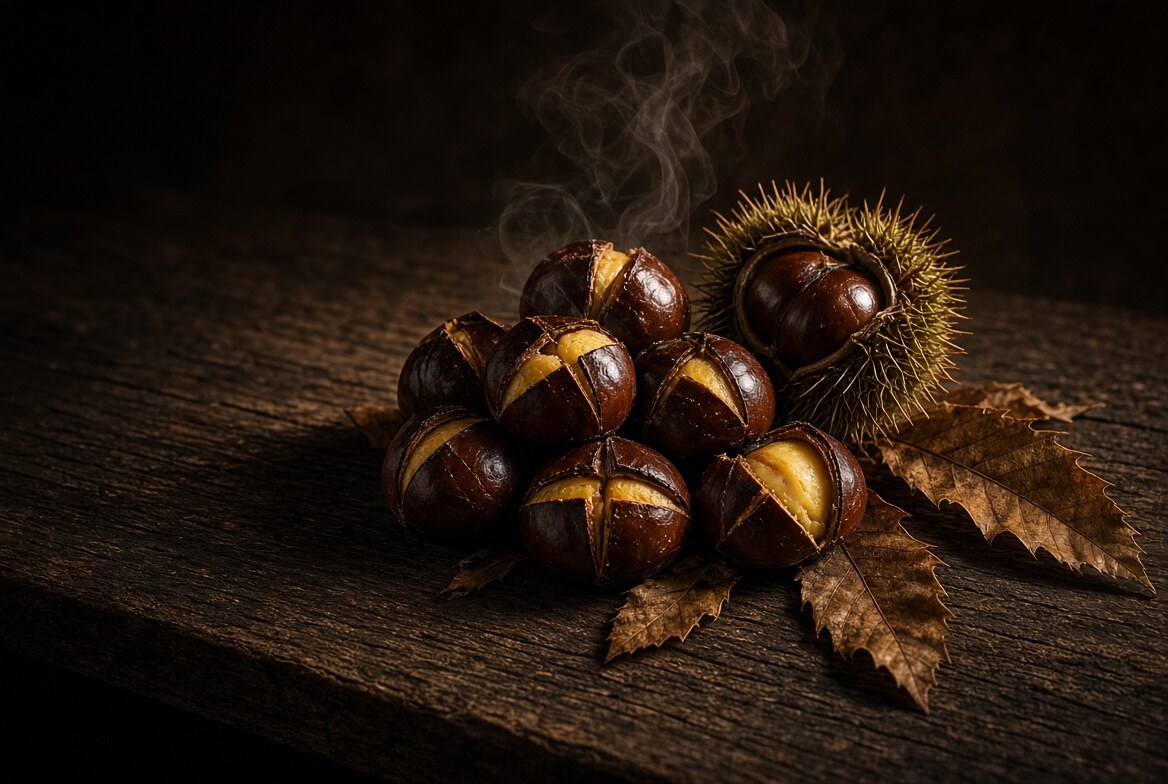
A November evening, on a street corner. In your hands, a paper cone of hot roasted chestnuts; on the vendor's sign, “marrons.” You don't think twice. Yet what you're peeling is almost certainly a châtaigne. And the only “marron” that really grows in town, under the schoolhouse windows, isn't edible.
One tree, two words
Châtaigne and marron come from the same tree, the sweet chestnut, a cousin of the oak and the beech (ENS de Lyon, biology department). Its spiny husk splits into four and usually releases three nuts.
What sets them apart comes down to a skin. Most châtaignes are partitioned: a thin membrane, the pellicle, divides the nut into several pieces. The marron, on the other hand, is a selected variety that bears just one large nut per husk, in a single piece (ENS de Lyon).
In trade, the rule is looser: a variety can be called marron if, on average, no more than 20% of its nuts are partitioned (Chambres d'agriculture). For candied chestnuts, confectioners prefer large late-season châtaignes, the Bouche Rouge and the Comballe, for their marrons glacés (Interfel).
So nobody lied to you. Hot chestnuts, chestnut cream, marrons glacés: usage simply kept the prettier word.
The horse chestnut, on the other hand, isn't edible
The real trap grows in parks, where the horse chestnut tree drops its conkers. This seed, from a completely different botanical family, is toxic: abdominal pain, nausea, vomiting, an irritated throat (Que Choisir). Between 2012 and 2018, this mix-up accounted for 11% of the plant confusions reported to French poison control centers, according to ANSES (Que Choisir).
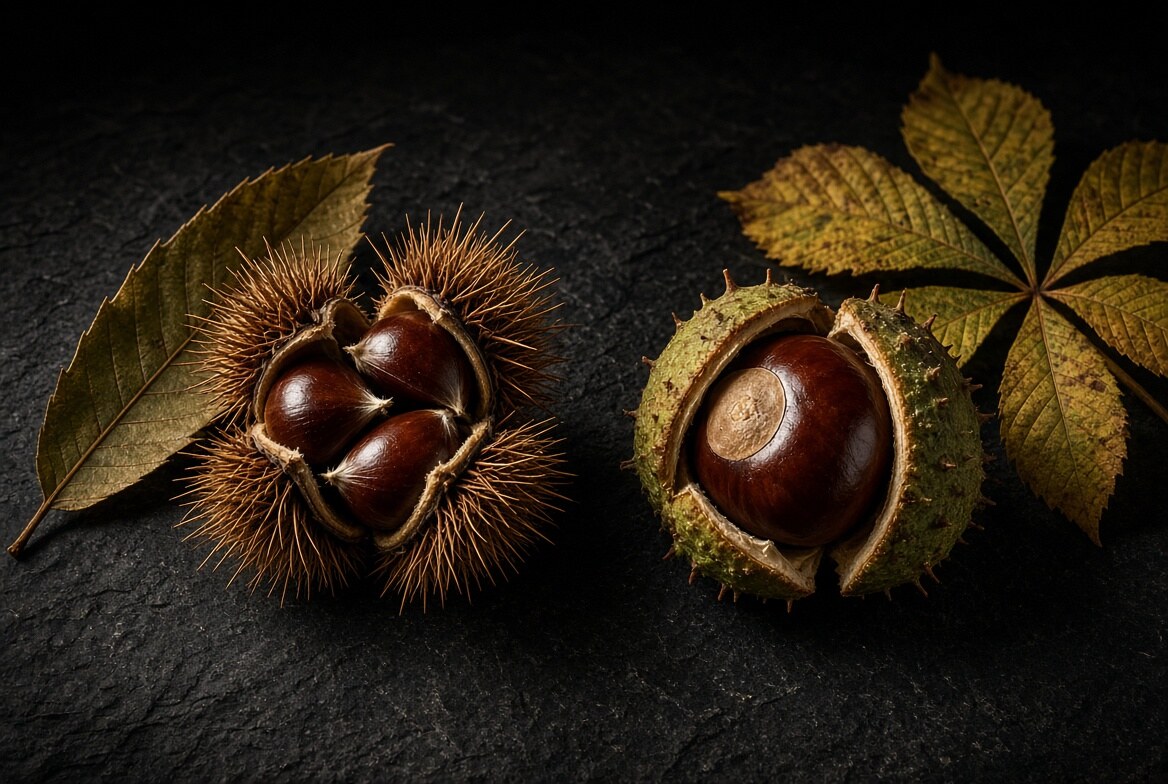
The smart move Look at the husk. Sweet chestnut: brown, bristling with long, tightly packed spines, two to four flattened nuts inside. Horse chestnut: thick shell, green before turning brown, a few short, widely spaced spikes, a single big, perfectly round nut (Que Choisir). If in the slightest doubt, don't eat it.
Ardèche, far ahead
Every year, France harvests around 8,860 metric tons of chestnuts and imports roughly as much, from 9,000 to a little over 10,000 metric tons, mostly from Spain, Italy and Portugal (Chambres d'agriculture). On its own, Ardèche supplies 44% of national production, ahead of Dordogne and Lozère (Chambres d'agriculture).
Its protected designation of origin covers 197 municipalities, almost all in Ardèche, plus a few in the Gard and the Drôme. Only the old local varieties qualify, hybrids are excluded, and fresh chestnuts sold under the designation run no more than 100 nuts per kilo (INAO, specifications).
Every fall, the region celebrates its harvest: in 2026, the Castagnades festivals were scheduled in eleven villages of the Monts d'Ardèche, from October 10 to November 8 (Onivapp).
Choosing, storing, cooking
At the market, pick them shiny and very firm: a fresh chestnut doesn't give under your thumb (University of Missouri, 2009). On storage, the sources disagree. Interfel says 4 to 5 days in the crisper drawer (Interfel), the University of Missouri a few weeks in the refrigerator, in a ventilated bag (University of Missouri, 2009). When in doubt, go with the shorter time.
No rush? Leave them three to five days at room temperature before cooking: some of the starch turns into sugar, and they get sweeter (University of Missouri, 2009).
Before cooking, scoring them is non-negotiable. A fresh chestnut is 40 to 50% water: with no way out, the steam makes it burst. A single slit is enough to let it escape; two in a cross also make peeling easier (University of Missouri, 2009).
For the oven, the University of Missouri gives 25 minutes at 218 °C (425 °F) on a baking sheet. Let them rest five minutes, then peel them while still hot, shell and thin skin together: once cold, they resist (University of Missouri, 2009).
The verdict What you buy under the name marron is almost always a châtaigne, and that's just fine. Only steer clear of the one from the parks: short spikes, one round nut, it isn't edible.
To go further
- Soupe de châtaignes ardéchoise
- Velouté de châtaignes
- Gâteau ardéchois à la crème de marrons
- Ardèche and its recipes
Sources — ENS de Lyon, “Châtaigne ou marron ? Le regard du botaniste” · Chambres d'agriculture, chestnut and marron production in France · Interfel, chestnut fact sheet · Que Choisir, 2019 · INAO, Châtaigne d'Ardèche specifications · Onivapp, Castagnades 2026 · University of Missouri, 2009
Image credits — All images in this article are AI-generated for Le Chaudron (illustrations, not documentary photos).