Before pumpkins, people carved turnips: the real story of Halloween
Since when have we carved pumpkins? Not as long as you think, and not where you think. The history, tips for nailing yours, and what to do with the flesh.
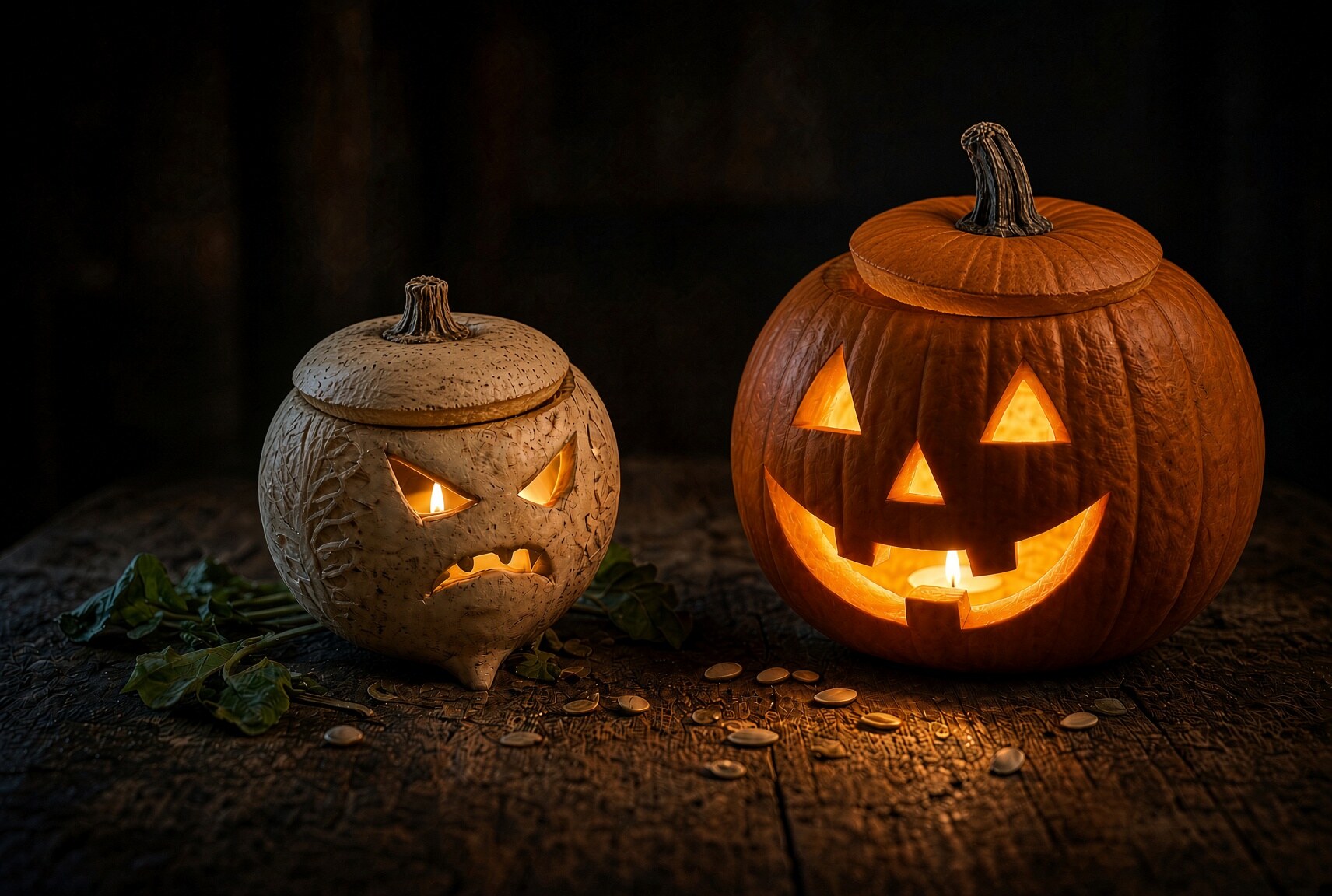
The evening of the 31st: you're carving your pumpkin over a sheet of newspaper, and the kitchen smells of toasted seeds. Two centuries earlier, on an Irish farm, it would have been a turnip being hollowed out. Smaller, harder, and frankly less smiley.
Before the pumpkin, the turnip
It all starts with Samhain, the Celtic festival that marked the end of summer, from October 31 to November 1: people believed the boundary between the living and the dead grew thinnest then (Smithsonian Magazine).
To keep spirits away, people carved faces into turnips, potatoes or beets, with a candle inside. The practice is found in Ireland and the Celtic countries in the 19th and early 20th centuries (Smithsonian Magazine). These vegetables also had a down-to-earth advantage: a metal lantern was expensive (National Geographic).
One piece of evidence still exists: the National Museum of Ireland keeps a cast of a turnip lantern from Donegal, with a pinched, angry face, donated in 1943 by a schoolteacher (Smithsonian Magazine).
Jack, the blacksmith who tricked the devil
The name comes from an Irish legend. Jack, a stingy blacksmith, tricks the devil twice. When he dies, neither heaven nor hell will have him: he wanders the night with an ember to light his way (History.com).
On the date, the sources disagree. National Geographic traces the tale back to the 18th century; History.com sees it appear in writing in the 19th (National Geographic; History.com). As for the term “jack-o'-lantern,” in 17th-century Britain it first referred to night watchmen and to will-o'-the-wisps in the marshes (National Geographic).
America changes vegetables
Crossing the Atlantic, Irish and Scottish immigrants found a local plant there that was much easier to hollow out than the turnip: the pumpkin (University of Notre Dame).
The first carved pumpkins appear in American texts in the 19th century: in Nathaniel Hawthorne as early as 1835, then as an illustration in Harper's Weekly of November 23, 1867 (National Geographic; University of Notre Dame). Game over for the turnip.
In France, it all started at the Trocadéro in 1997
Before then, Halloween was almost unknown in France. That year, France Télécom launched a campaign for its mobile phone and displayed more than 8,000 pumpkins at the Trocadéro; the price of pumpkins rose 12.5% (The New York Times, 10/31/1997). Two years later, the big brands had all jumped in (Slate.fr).
Yet France already had its own lanterns. Until the early 20th century, in Brittany, children hollowed out beets and turnips into skull shapes, with a candle inside. In the Moselle, people celebrated “Rommelbootzennaat,” the night of the grimacing beets (Slate.fr).
After a lull, the holiday came back: 60% of French people said they celebrated it in 2022 (Slate.fr).
Nailing your pumpkin this year
Choose it for carving, not for soup: carving varieties, such as Rocket or Howden, are bred for their shape and sturdiness (Famigros).
Cut the lid at an angle toward the inside, so it doesn't fall in, or simply open it from the bottom (This Old House). Scrape the walls down to 1.3 to 2 cm (½ to ¾ in) thick, depending on the tutorial: the thinner it is, the more light shines through (This Old House; Zwilling).
Keep it cool, ideally between 10 and 15 °C (50 and 59 °F), and bring it inside if it freezes (Farmers' Almanac). Several sources recommend coating the cut edges with petroleum jelly to slow drying, with a warning: it's flammable, so no candle in a coated pumpkin (FOX 26).
The smart move An LED candle rather than a real flame: that's the safest choice according to the American firefighters of the NFPA (NFPA, via the State of Connecticut), and the pumpkin shrivels more slowly.
Four serious tutorials to go further, stencils and tools included:
- Carving a Halloween pumpkin, knife by knife — Zwilling
- Choosing, hollowing and lighting your pumpkin — Famigros
- How to carve a pumpkin, with the stencil pricked through with a toothpick — This Old House (in English)
- 5 tips to keep it from rotting — Consoglobe
What about the flesh?
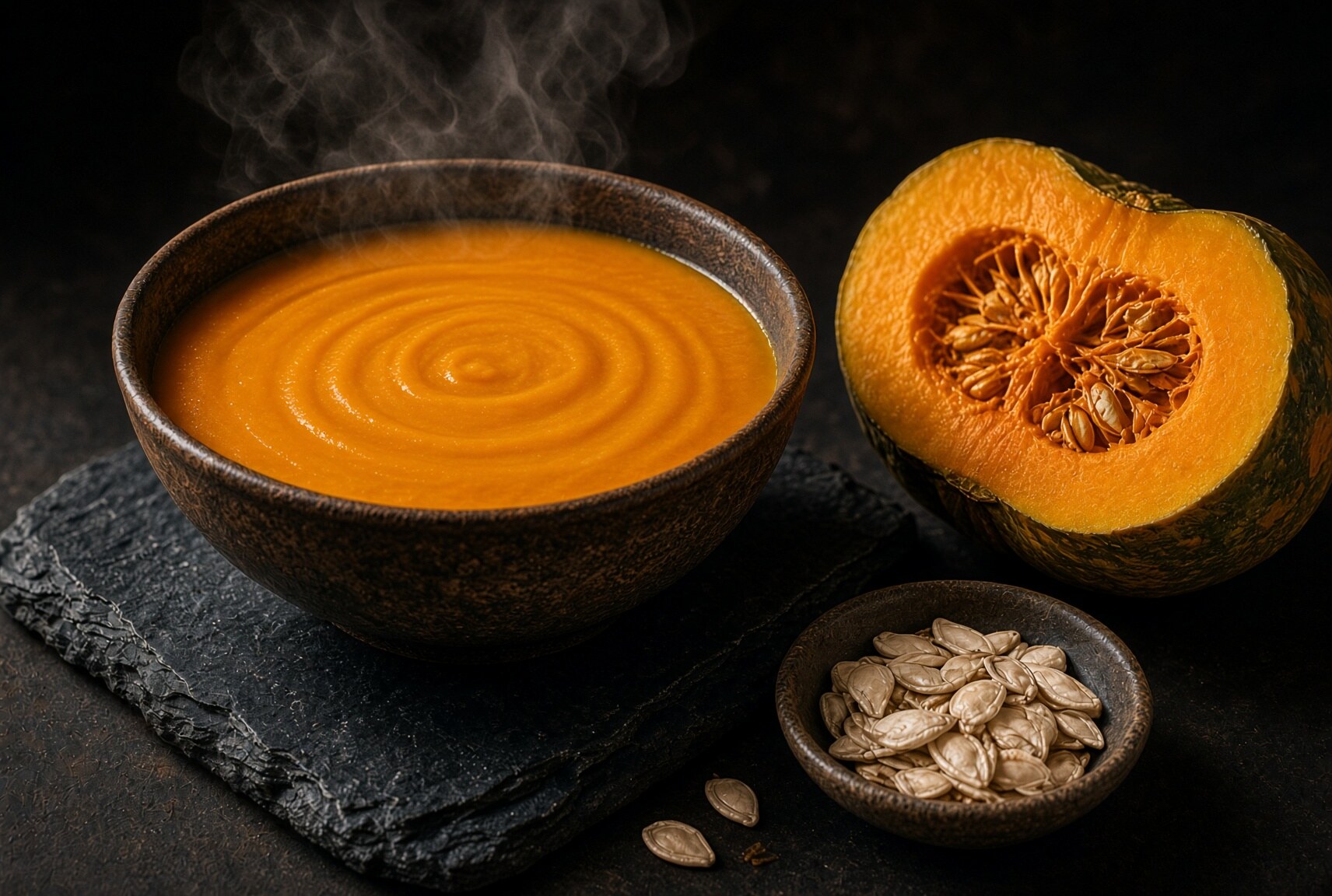
Bad news for soup: a carving pumpkin has little flavor once cooked (UGA Extension). Its flesh is stringier and more watery than that of a cooking pumpkin (Jardiner Malin).
You can still save the flesh and seeds, as long as you cook them right away: once cut, a pumpkin spoils fast, and a lantern left on the porch for several days is no longer edible (Paris Match Belgique). The seeds, for their part, can be roasted in the oven with a drizzle of oil and spices (University of Illinois Extension).
For the evening's soup, you're better off buying a red kuri squash or a cooking pumpkin on the side.
The verdict The Halloween pumpkin is a 19th-century American invention, heir to the carved turnips of Ireland and to our Breton beets. Carve it for the window, but keep a red kuri squash for the soup.
To go further
Sources — Smithsonian Magazine · National Geographic · History.com · University of Notre Dame, Rare Books & Special Collections · The New York Times, 1997 · Slate.fr · Famigros · This Old House · Zwilling · Farmers' Almanac · FOX 26 · NFPA · UGA Extension · Jardiner Malin · Paris Match Belgique · University of Illinois Extension
Image credits — All images in this article are AI-generated for Le Chaudron (illustrations, not documentary photos).