T45, T55, T65: which flour for which dough
The number on the bag doesn't mean what you think. We explain what it really measures, and which flour to keep in the cupboard.
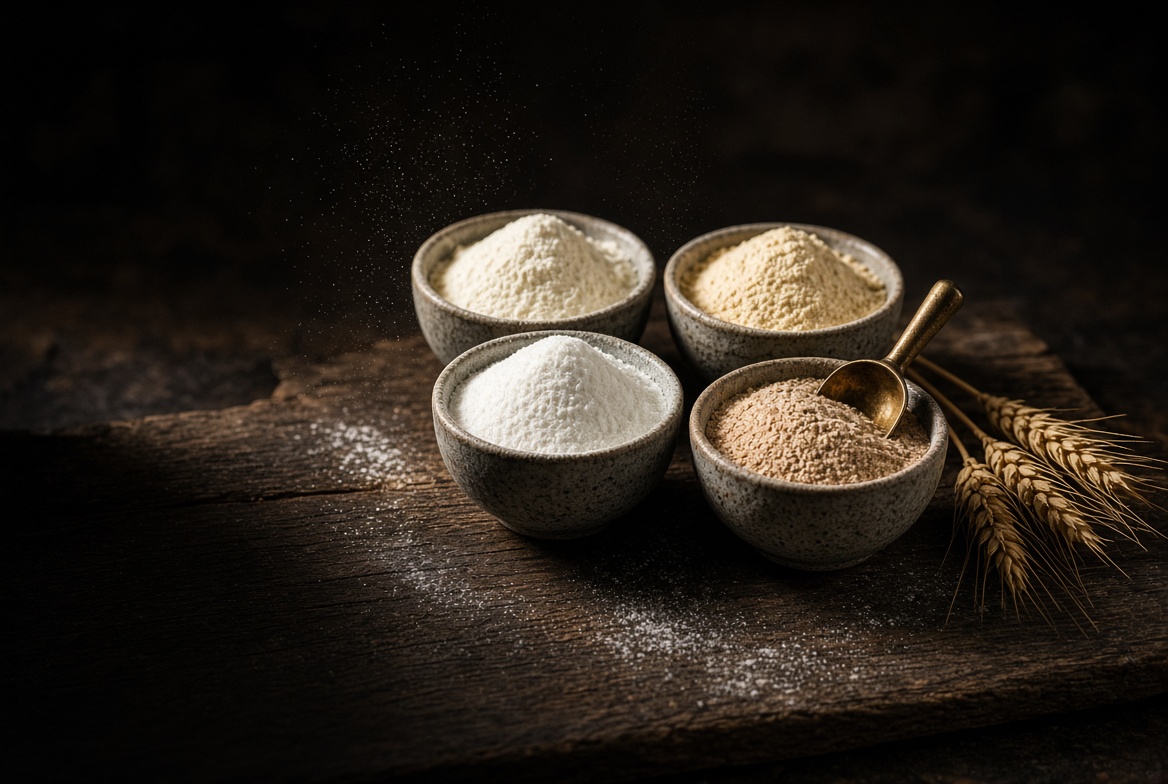
In the flour aisle, you choose between six nearly identical bags. T45, T55, T65, sometimes T80 or T110. Into the cart goes the one your grandmother used to buy, or the one on sale. Then one day your brioche collapses, and you wonder whether it was the right one.
Good news: there aren't six flours to know. There are two, plus one question to ask yourself.
T for type: what's left when you burn the flour
Behind the number is a slightly strange measurement: a flour sample is burned and what remains is weighed. That residue is the mineral content, called ash (Académie de Versailles, course “Farines – Définitions”).
Minerals are found mostly in the outer layer of the grain, the bran. So the higher the number, the more bran the flour contains, and the more whole-grain it is (Académie de Versailles, summary “La farine”). In France, this classification has existed since 1963 (FranceAgriMer).
| Type | Ash (% of dry matter) | In practice |
|---|---|---|
| T45 | under 0.50% | the whitest |
| T55 | 0,50 à 0,60 % | white, the most common |
| T65 | 0,62 à 0,75 % | light brown |
| T80 | 0,75 à 0,90 % | brown |
| T110 | 1,00 à 1,20 % | semi-whole wheat |
| T150 | over 1.40% | whole wheat |
Source: FranceAgriMer, survey of flour types.
The trap: the T says nothing about strength
Lots of people get this wrong. They think a T45 is “finer” and therefore lighter, and that a T55 is “sturdier.” But the type doesn't measure that.
Whether a dough holds together is a matter of gluten, and so of the wheat's proteins. Yet there's no link between ash content and the amount of protein. At an INRAE / AgroParisTech seminar in 2024, a T45 and a T55 from the same mill showed exactly the same protein content: 11.7%. And their tests on pastry doughs for lining tart pans showed no effect of the type on consistency (INRAE / AgroParisTech, 2024).
Gruau flour is high in protein: the Label Rouge specifications require at least 12.5% protein (INAO). That's what gives a brioche or a croissant the strength to rise without sagging.
The smart move Looking for structure? Forget the T45 on the bag. Look for gruau, or “farine de force” (strong flour).
Which flour for which dough
Here's what the CAP Pâtissier (French pastry diploma) textbook teaches (Delagrave), supplemented by the Académie de Versailles courses:
| Dough | flour |
|---|---|
| Choux pastry | T45 |
| Puff pastry | T45 |
| Brioche | T45 or gruau |
| Croissant | T55 or gruau |
| Pâte brisée | T55 |
| Everyday bread, pizza | T55 |
| Country bread | T80 or T110 |
| Whole wheat bread | T150 |
| Fresh pasta | durum wheat semolina rather than flour |
For sweet shortcrust, the sources disagree: T45 for all pastry according to the Académie de Versailles, T55 or T65 for cookies according to the miller Francine (Francine). Given what we just said about strength, you can use whatever you have.
Italian 00 flour: what do you do with it?
It shows up in every pizza recipe. On the Italian side, the law sets a maximum of 0.55% ash for 00 (decree DPR 187/2001). On paper, it therefore sits between our T45 and our T55. No official equivalence exists, but for homemade pizza, a T55 does the job: in fact, it is the flour used in our Neapolitan pizza.
The verdict Keep two bags: a T45 for delicate pastry (choux, puff pastry) and a T55 for everything else (bread, pizza, pie dough). If your brioche lacks structure, don't change the T: use gruau flour.
To go further
- Brioche maison — it calls for a T45
- Pizza napolitaine maison
- Pain de campagne maison
- Sablés bretons
Sources — FranceAgriMer · Académie de Versailles, “Farines – Définitions” · Académie de Versailles, “La farine” · INRAE / AgroParisTech, November 2024 seminar · INAO, Label Rouge gruau flour specifications · Delagrave, CAP Pâtissier · Francine · DPR 187/2001
Image credits — All images in this article are AI-generated for Le Chaudron (illustrations, not documentary photos).